Farang
Farang (ฝรั่ง) is the everyday Thai word for a foreign person of Western appearance. It isn't a slur or officially negative — it's used neutrally in daily conversation, on price signs, and even in the name of a Western-origin fruit, guava (farang). Its origin is debated among linguists, though one widely cited theory links it to the word historically used across Asia for the Franks and, by extension, Europeans. For many of the foreigners in our stories, hearing the word farang is one of the first cultural experiences of arriving in Thailand.
Frequently asked questions
Is "farang" an offensive word?
No, it's generally a neutral, descriptive term, similar to "foreigner." It can sound impersonal, but it's rarely used with disrespectful intent in everyday speech.
Does farang only refer to white foreigners?
It's traditionally associated with people of Western appearance, though its colloquial use has broadened to refer to foreigners in general, without strict ethnic distinction.
Where does the word farang come from?
The most accepted theory links it to "Frank," the historical term used across Asia for Europeans, which was phonetically adapted across different regional languages.
Stories related to Farang
She helped me find my hotel on day one in Bangkok. Twelve days later I found out her name, her age, and almost everything she'd told me was a lie.
A 31-year-old Australian meets Noi when she offers to help him find his hotel in Asok, Bangkok. Twelve days of perfect attention later, on their last day together, she tells him she loves him just as her ID card reveals a name and age completely different from what she'd given him from the start.
I had over a hundred matches on a dating app my first night in Asia. One crossed a border to meet me, and turned out to be married, with three kids.
A 26-year-old Australian engineer, freshly arrived in Asia for a hydro power job, downloads a dating app his first night in Vientiane and racks up a hundred matches in hours. A Thai woman crosses the border from Nong Khai to meet him. Days later, a Facebook search reveals she's married to a wealthy European man and has three kids.
Om never asked me for a penny in two years. Now she runs Thai nights at our pub.
A 26-year-old Brit met Om in a bar on Soi Buakhao, Pattaya, then found her again months later serving coffee off Beach Road. Two years of her never asking for anything, a complicated visa and a wedding later, they now run a pub in England with Thai theme nights.
She gave me a free bowl of noodles at her mum's stall. The buffalo has never been sick.
A 50-year-old Brit, freshly divorced, met Nitia, a maths teacher in Khon Kaen who'd spent years keeping men at arm's length. Years of FaceTime, visits dodging COVID, and a first daughter later, the wedding is no longer a possibility but a foregone conclusion.
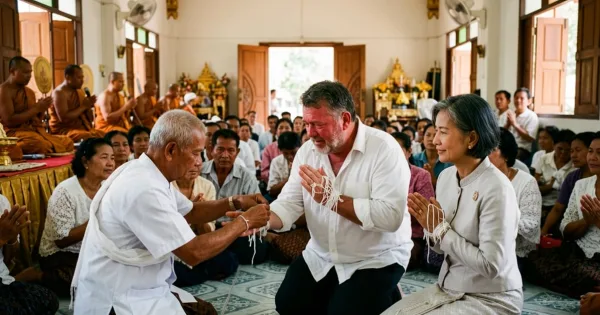
I told her I wouldn't send a single baht until we met in person. She accepted without arguing.
A 61-year-old American recounts how, after a failed relationship in Vietnam, he met May, a refreshingly honest Thai civil servant. Years of video calls and a temple wedding in Kanchanaburi with nearly 50 blessing strings later, he gained an entire family.