Long Distance
In short
Many relationships here start with an ocean between two people — after a holiday ends, or built entirely online before a flight was ever booked. The typical pattern is escalating visits until one person relocates, usually the foreigner moving to Thailand; distance also makes it harder to verify what the other person says, which is worth being alert to.
Many relationships between foreigners and Thai women start with thousands of kilometers in between, whether because the foreigner returns home after a holiday or because the relationship began entirely online. This guide explores how these long-distance relationships actually work and what sets them apart from other stories on this site. See our Dating Apps guide too if the relationship started entirely online, before any in-person meeting.
What does this actually mean?
Geographic distance adds an extra layer of complexity to any relationship: calls at awkward hours due to the time difference, careful planning of visits, and the constant uncertainty of not knowing when the next in-person meeting will be. Many of these relationships start after a holiday in Phuket, Pattaya or Koh Samui, once the visitor has already gone home but the connection with the person they met there hasn't faded.
Common patterns
The most common pattern is a gradual escalation of increasingly frequent and longer visits, until one of the two people decides to relocate permanently, usually the foreigner moving to Thailand. How long that process takes varies enormously: from a few months to several years of intermittent visits. Distance is also, unfortunately, a context that makes certain kinds of scam in Thailand easier, precisely because it makes it harder to verify what the other person says.
Practical advice
Video calling regularly, visiting in person as soon as possible, and not rushing big decisions — like a wedding in Thailand or sending money — before spending real time together are the most repeated recommendations. Distance isn't an insurmountable obstacle, but it demands more patience and more verification than a relationship built face-to-face from the start.
Frequently asked questions
How do these couples stay in touch despite the time difference?
Through scheduled video calls at times that work for both, constant messaging throughout the day, and visits planned as far in advance as possible to reduce uncertainty.
How long does it usually take before someone relocates?
It varies a lot, from a few months to several years of intermittent visits, depending on both people's work, financial and family situations.
What are the biggest challenges of a long-distance relationship in this context?
The difficulty of verifying what the other person says, the financial cost of frequent trips, and the pressure to make big decisions — like a wedding — without ever having lived together.
Does distance increase the risk of a scam?
Yes, precisely because it makes direct verification harder. The usual warning signs — money requests, resistance to video calls — deserve even more attention when the relationship is entirely long-distance.
Stories about Long Distance

I fell asleep without locking my phone on the last night of the holiday. She saw my Line history, and that was the end of it.
A 54-year-old Frenchman meets Amara, a 39-year-old chef, on his first day in Phuket, and within 24 hours he already has a holiday girlfriend. Months later, in Koh Samui, an unlocked phone reveals his Line history to her: dozens of conversations with other girls that put an end to something that, until that night, had been genuinely special.

An Australian messaged me to say the woman I'd fallen for was his girlfriend of a year. Today she's my wife.
At 44, divorced for a decade, an American meets Tay on Facebook. A month later, already in love, he finds out she'd spent the past year with an Australian man who'd visited her village in Isan. She confesses everything honestly and asks for one chance. Years later, they're married and building a house to retire in.

She helped me find my hotel on day one in Bangkok. Twelve days later I found out her name, her age, and almost everything she'd told me was a lie.
A 31-year-old Australian meets Noi when she offers to help him find his hotel in Asok, Bangkok. Twelve days of perfect attention later, on their last day together, she tells him she loves him just as her ID card reveals a name and age completely different from what she'd given him from the start.

A trip to Vietnam taught me to tell lust from love. I went back to Thailand, met a woman 24 years younger than me, and I'm about to propose.
A 52-year-old Canadian, after mistaking lust for love on a trip to Vietnam, goes back to Tinder looking for something real and meets a Thai woman of Chinese descent 24 years younger than him. Three weeks together across Bangkok, Pattaya and Koh Samui become the start of a long-distance relationship that, bumps and all, is still going strong toward a proposal.
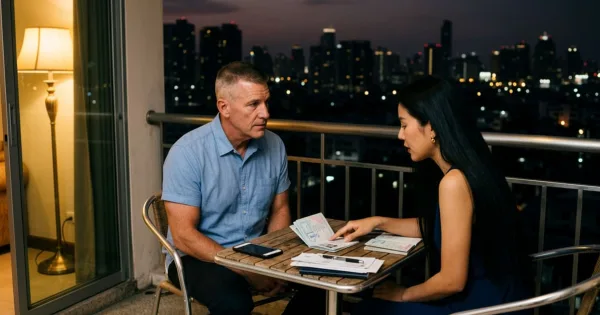
I checked her passport, her certificates, years of photos. It all lined up. It cost me $30,000 to learn that wasn't enough.
At 57, living in the quiet peace of a marriage that survived my wife's third affair, I met Pre at a bar in Nana Plaza, Bangkok. She was 37, looked 25, and had a perfectly verifiable story: passport, divorce papers, years of social media photos. Over six months I sent her 30,000 dollars for her family, her studies, and a Denmark visa that never came through.

She'd step outside to take calls from other guys. At least she was honest about it.
A Portuguese man used the Phuket Sandbox for a no-strings escape and ended up with Som, 32, three months of hidden beaches and one clear rule from day one. Four months later he understood she'd never really stopped keeping her options open.