Scams
In short
Romance scams in Thailand tend to follow a pattern: a fast-moving relationship, intense emotional connection, then a sudden financial 'emergency.' The person isn't always malicious from the start — sometimes a genuine relationship deteriorates into unreasonable requests. Early money requests and resistance to verifying identity, stacked together, are the strongest warning signs in our stories.
Not every love story in Thailand is what it seems, and this site includes several where trust broke down after discovering the real interest was money. This guide gathers the most common scam patterns documented in our stories, to help tell a real relationship problem apart from deliberate deception. For the opposite pattern — relationships where money was never the goal — see our Thai Women Beyond Stereotypes guide too.
What does this actually mean?
Romance scams in Thailand tend to follow a recognizable progression: a relationship that moves very fast, an intense emotional connection built in a short time, and then the appearance of an "emergency" that requires urgent money. It doesn't always involve a person who was malicious from the start; sometimes the relationship begins genuinely and deteriorates into increasingly unreasonable requests when real financial difficulties arise.
Common patterns
Among the most repeated patterns are requests for money for a supposed dowry, sudden family problems that always get resolved with a transfer, pressure to rush a wedding in Thailand without having met in person, and refusal to video call or meet physically. Bangkok and Pattaya show up often as the setting for these cases, though they can happen in any city in the country.
Practical advice
No single sign is definitive proof of a scam, but several stacking up — especially early money requests and resistance to verifying the other person's identity — should raise every alarm. Taking time, verifying whatever information can be verified, and not sending money before meeting in person are the most effective measures mentioned in our stories. For a fuller breakdown of these warning signs, see our guide to Red Flags.
Frequently asked questions
What are the most common scam patterns?
Requests for money for sudden family emergencies, pressure to rush wedding or visa paperwork, and resistance to video calls or in-person meetings are the most frequent ones in the stories documented here.
How much money is typically involved in a scam?
It varies enormously: from small repeated amounts to sums of hundreds of thousands of baht in the most serious cases documented in our stories.
Are Thai dating scams usually run by one person or an organized group?
Often organized: many documented cases follow near-identical scripts and timing across unrelated stories, suggesting shared methods or coordinated operations rather than one person improvising alone. Whether the money can be recovered afterward is covered in our dedicated FAQ on that question.
What's the difference between a scam and a genuine relationship with difficulties?
Intent. A genuine relationship with financial difficulties usually shows transparency, willingness to talk openly about the problem, and no pressure to act immediately; a scam depends precisely on urgency and a lack of verification.
Stories about Scams

I followed her one day instead of believing her story about the family visits. She didn't go to the bus station — she walked into a hotel with another man.
Retired in Pattaya since 2017, a 55-year-old Polish man falls for Apple, a 32-year-old bar girl with three kids to support. For months he believes he's the only man helping her out financially. One day he decides to follow her instead of believing the usual excuse, and discovers he was just one of several sponsors supporting her at the same time.
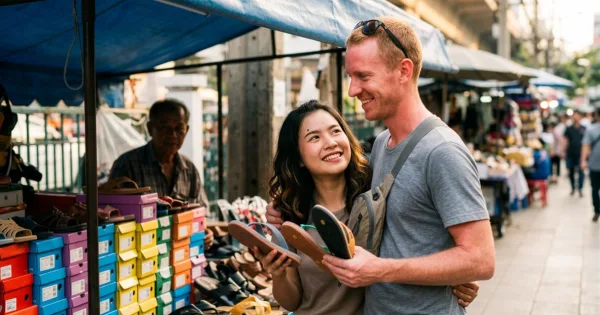
She helped me find my hotel on day one in Bangkok. Twelve days later I found out her name, her age, and almost everything she'd told me was a lie.
A 31-year-old Australian meets Noi when she offers to help him find his hotel in Asok, Bangkok. Twelve days of perfect attention later, on their last day together, she tells him she loves him just as her ID card reveals a name and age completely different from what she'd given him from the start.
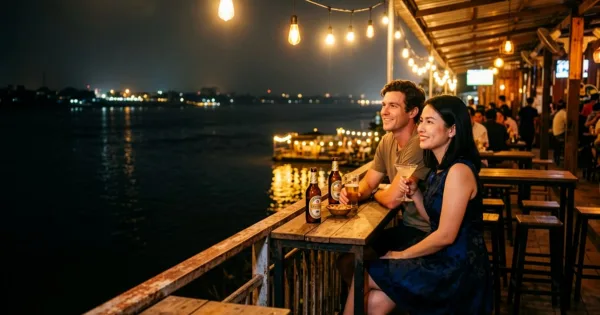
I had over a hundred matches on a dating app my first night in Asia. One crossed a border to meet me, and turned out to be married, with three kids.
A 26-year-old Australian engineer, freshly arrived in Asia for a hydro power job, downloads a dating app his first night in Vientiane and racks up a hundred matches in hours. A Thai woman crosses the border from Nong Khai to meet him. Days later, a Facebook search reveals she's married to a wealthy European man and has three kids.

She was the perfect wife for eleven years. Then she used the visa, the custody courts, and social services to walk away with everything.
A British engineer married Knock, a woman from a respectable Bangkok family, and for eleven years she was the perfect wife. Once they moved to the UK on a spouse visa that cost two years and a fortune, everything changed: total control of the money, a women's shelter, a custody battle, and an ending he never saw coming.
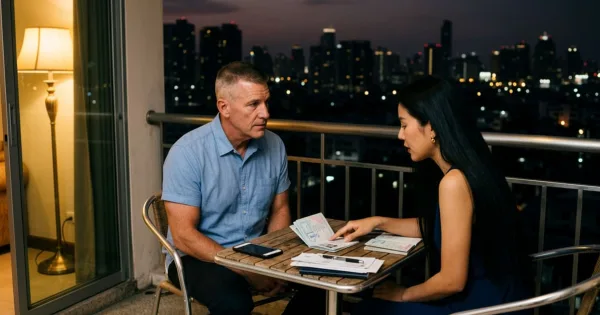
I checked her passport, her certificates, years of photos. It all lined up. It cost me $30,000 to learn that wasn't enough.
At 57, living in the quiet peace of a marriage that survived my wife's third affair, I met Pre at a bar in Nana Plaza, Bangkok. She was 37, looked 25, and had a perfectly verifiable story: passport, divorce papers, years of social media photos. Over six months I sent her 30,000 dollars for her family, her studies, and a Denmark visa that never came through.

12,500 baht for two bottles of wine. As I got out of the taxi, I watched the manager get in with her.
An Austrian met a woman from Thai Friendly in Bangkok: an expensive dinner, a shady venue, another bottle of wine, and a 12,500 baht bill topped off with a guilt trip about losing face. The final scene outside his hotel made everything clear.