She was the perfect wife for eleven years. Then she used the visa, the custody courts, and social services to walk away with everything.
In short
A British engineer married Knock, a woman from a respectable Bangkok family, and for eleven years she was the perfect wife. Once they moved to the UK on a spouse visa that cost two years and a fortune, everything changed: total control of the money, a women's shelter, a custody battle, and an ending he never saw coming.
I came to Thailand for work, not for the bars.
That part never interested me. I preferred the clubs in Bangkok and Pattaya on weekends, loud music, groups of colleagues, nothing more. I was an engineer, British, on a three-year contract with an energy company operating out of Bangkok, and I thought it would just be another stretch of my career. Eleven years later I was still there, married, with a daughter, and an entire life built on what I believed was solid ground.
I met Knock through a colleague from the office, at a company dinner she'd come to accompanying her sister. She was shy, said little, from a respectable Bangkok family: her father had worked at a bank his whole life, her mother ran the household with a discipline that struck me, newly arrived, as almost military. Nothing like what I'd expected to find on a Saturday night out at the clubs.
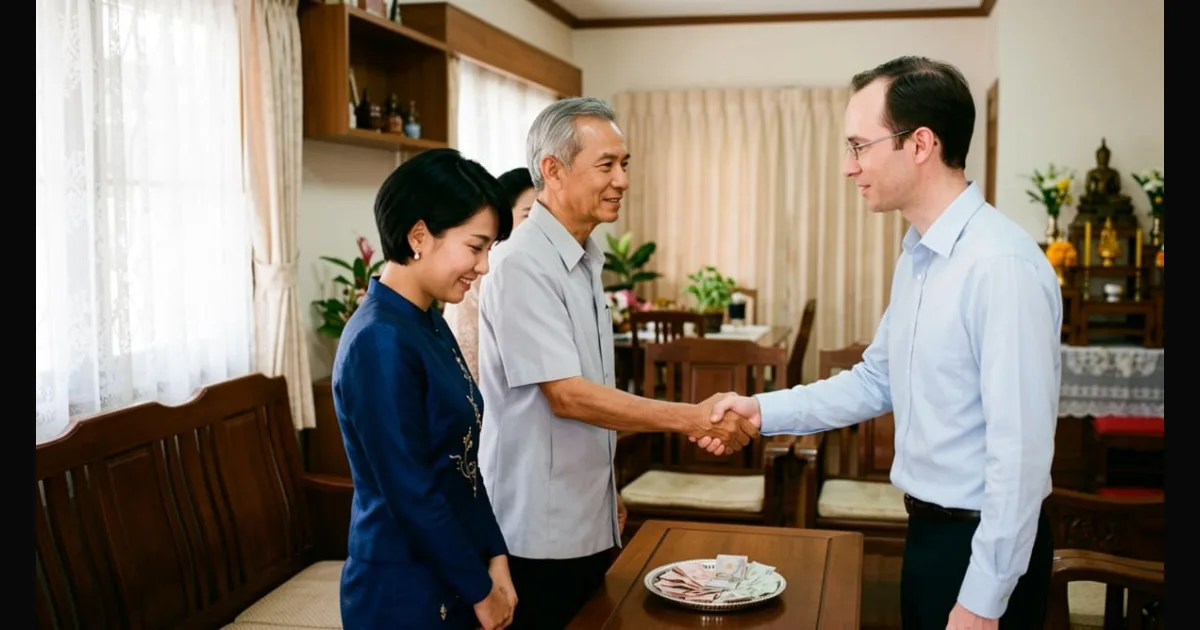
The courtship was long, as her family's tradition demanded. Sunday visits with flowers for her mother, her parents' permission before every date, months before she'd even let me hold her hand in public. I remember the first time I took her to dinner without a chaperone: she spent half the meal watching the door, convinced her father was going to walk in. When I finally proposed, I insisted on doing it properly: I went to her house with my Thai boss as go-between, we paid a modest but respectable sin sod, and her father shook my hand like I'd just passed an exam he'd been setting me for two years.
We married, and for eleven years Knock was, by any reasonable measure, the perfect wife.
We lived in central Bangkok, surrounded by every distraction imaginable for a foreigner with money: bars, clubs, women who worked precisely to do what I never did. Colleagues at the office would half-joke, half-warn me: "enjoy it while it lasts, nobody stays faithful here forever." I stayed faithful the whole time anyway, never once tempted to test whether the marriage could survive it. I bought land on the outskirts, then a house Knock decorated room by room over the best part of a year, then an SUV so she could get around the city without relying on taxis.
She traveled with me every time work took me out of Thailand: came to the UK several times, saw snow for the first time in a Yorkshire car park and laughed for a good half hour, we covered half of Europe together by train and rental car, always a smile for the cameras and endless patience with my family, who didn't always make it easy for her — my mother especially, who took years to stop asking me if I was "completely sure." Our daughter was born, we named her Mali, and for a while life was exactly what I'd imagined without ever quite daring to ask for it.
Then the company moved us permanently to the UK.
Getting Knock a spouse visa cost us two years and an amount of money I still can't mention without feeling angry. UK immigration is brutal even when you're earning what I was, with free accommodation, with a spotless record, with eleven years of marriage documented photo by photo, flight booking by flight booking. We filled out forms that asked for evidence of every Christmas we'd spent together, paid immigration lawyers in London who charged by the hour like surgeons, waited months without a response while Mali started school with just me and asked every night when her mother would arrive. Eventually, they arrived.
From the day she landed, something changed.
Knock demanded total control of our money, down to the last penny of my salary, every month, no exceptions. She refused to work, to integrate, to learn the language beyond what she needed at the supermarket. She refused the car I bought her, the same kind she'd happily driven in Bangkok. She refused a well-stocked bank account I opened in her name so she'd have some independence, saying she'd rather everything went through me. She refused flights to visit the same relatives in Europe she'd loved visiting years before. Nothing was ever enough, and the strange part was she'd refuse the exact things she claimed to want whenever we argued. I started to feel like any solution I proposed was automatically the wrong one, not because it was, but because it came from me.
Eighteen months later, while our daughter was in hospital waiting for the first of four scheduled operations, Knock went back to Thailand.
I remember the last night before she left, sitting in the children's ward waiting room with a suitcase already packed in the car boot, something I didn't find out until days afterward. She told Mali, who was nine and had a cannula in her arm, that she was going on holiday and would be back soon. Mali asked me, back in the room, why mummy wasn't waiting until after the operation. I didn't know how to answer her without telling a smaller version of her mother's lie.
Six months later she came back saying she wanted a fresh start, that she was sorry, that things would be different this time. I believed her, or wanted to, for almost three weeks. She fell straight back into exactly the same pattern within weeks, only this time she started using our daughter as leverage directly: visits cancelled without explanation ten minutes before they were due, promises broken in front of the child, silences that lasted entire days as punishment for something I could never fully understand, no matter how much I asked.
One evening I came home from work earlier than usual and the house was empty. It wasn't just that Knock and Mali weren't there; the wardrobes were open, the girl's clothes were gone, Mali's school bag was missing from its spot by the door.
I called the police that same night, more frightened than I'd ever been. They found them hours later at a women's shelter on the edge of the city, where Knock had told a version of our marriage I didn't recognize at all: a controlling husband, a life she'd needed to escape. Nobody let me see Mali that night.
What followed was more than two years of family courts and Social Services: interviews with caseworkers who wrote down every word, psychological reports on Mali, a solicitor who ended up knowing my parents' names from how often we met. Every hearing brought a slightly different version of the story Knock had told that first night at the shelter. In the end, a judge granted me joint custody. By then Knock and Mali had moved to a different city without telling me, and she'd pulled Mali out of school overnight, without a word. I had to fight all over again — new city, new school system, waiting lists — to get her a place at a good school near where we both now lived. Today she's settled there, with real friends, a netball team, and grades that make her as proud of herself as they make me of her.
My ex has since had another child, with another man. I don't know who the father is and, honestly, I couldn't care less. The only relevant part is that, as I understand it, that child strengthens her right to remain in the UK indefinitely.
I pay for everything Mali needs: school, after-school clubs, trips. Last summer I organized a holiday back to Thailand with both girls, Mali and her half-sister; the two of them loved every minute of it — Bangkok, the beach, food Mali had been asking me to make for months. Knock came along because her other daughter is still too young to travel without her, and spent the entire trip in a foul mood, complaining about the heat, the traffic, a country she used to say she adored.
Meanwhile, back in Thailand, she's sold everything we had together: the house, the land, the SUV, things of mine I didn't even know she'd taken when she left.
I'm back working in Thailand now. I call Mali every day, whatever the time, even if it means waking up before dawn to catch her before school. I count down the days to school holidays, when she comes out to visit me. She's the first thing in my life, no argument about it. My ex, on the other hand, is nothing to me.
People hear "Thai wife" and picture a bar girl who scammed some lonely tourist out of a few thousand pounds for a sick buffalo that never existed. I used to picture it that way myself, before all this, quietly grateful I'd avoided that particular story. I hadn't avoided anything. I'd just been given a version with better production values and a much longer runtime.
I'm sharing this because I want one simple thing understood: it's not just the girls from the bars.
This woman came from a respectable family, played the long game for eleven years, and then methodically used the visa system, the custody system, and the benefits system to get exactly what she wanted.
You might think you know someone after more than a decade.
Sometimes you don't.
Continue reading
Related stories

An Australian messaged me to say the woman I'd fallen for was his girlfriend of a year. Today she's my wife.
At 44, divorced for a decade, an American meets Tay on Facebook. A month later, already in love, he finds out she'd spent the past year with an Australian man who'd visited her village in Isan. She confesses everything honestly and asks for one chance. Years later, they're married and building a house to retire in.

I found her dancing in a Soi Cowboy bar. Nine months later our daughter was born in Thailand.
A 31-year-old Romanian recounts how a cheap flight booked on a whim sent him back to Bangkok alone, where he reconnected with Jit at a Soi Cowboy bar. A pregnancy, months of paperwork and a wedding later, they're now a normal family in the UK.

I have been married nine years and have three kids. And for the first time, I do not know if I should stay.
A Canadian sailor has been married nine years to a woman from Pattaya and has three kids. Now he faces the hardest question of his life: stay or leave.

350 guests, a village chief consulting his charms for the date, and years later a message asking for a divorce.
A 50-year-old Australian recounts how a 350-guest Thai wedding in Phuket turned into a guest house in Patong, an affair with another woman, bar fights involving the police, and a final message asking for a divorce.
I checked her passport, her certificates, years of photos. It all lined up. It cost me $30,000 to learn that wasn't enough.
At 57, living in the quiet peace of a marriage that survived my wife's third affair, I met Pre at a bar in Nana Plaza, Bangkok. She was 37, looked 25, and had a perfectly verifiable story: passport, divorce papers, years of social media photos. Over six months I sent her 30,000 dollars for her family, her studies, and a Denmark visa that never came through.