Thai dating scams
In short
The most common Thai dating scams follow a pattern: a relationship that escalates very quickly, followed by a sudden family emergency requiring urgent money, resistance to video calls, and pressure to send money before ever meeting in person. No single sign proves a scam, but several together are a serious warning.
More context
These scams rarely start out obviously fake: they're usually built on a real or seemingly real emotional connection that intensifies in a very short time. The turning point comes with the first request for money, almost always framed as a one-off emergency — a sick relative, a legal problem, an unexpected expense — that gets resolved, supposedly, with a transfer. If that first request works, it's common for it to repeat with new, increasingly less believable emergencies. Resistance to video calls or setting an in-person meeting, along with family stories whose details shift over time, are signs that show up again and again in the cases documented on this site.
Related questions
How can I verify if my Thai partner is real?
Through regular video calls, checking for consistency in what they say about themselves over time, and paying attention to how they react to direct, reasonable questions.
What should I do if I think I'm being scammed?
Stop sending money immediately and talk to someone you trust outside the relationship before deciding anything else. If money has already been lost, our dedicated FAQ on recovering funds after a scam covers the realistic next steps.
Related stories

I followed her one day instead of believing her story about the family visits. She didn't go to the bus station — she walked into a hotel with another man.
Retired in Pattaya since 2017, a 55-year-old Polish man falls for Apple, a 32-year-old bar girl with three kids to support. For months he believes he's the only man helping her out financially. One day he decides to follow her instead of believing the usual excuse, and discovers he was just one of several sponsors supporting her at the same time.
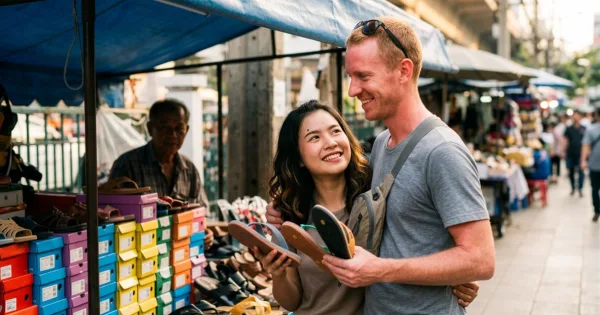
She helped me find my hotel on day one in Bangkok. Twelve days later I found out her name, her age, and almost everything she'd told me was a lie.
A 31-year-old Australian meets Noi when she offers to help him find his hotel in Asok, Bangkok. Twelve days of perfect attention later, on their last day together, she tells him she loves him just as her ID card reveals a name and age completely different from what she'd given him from the start.

I had over a hundred matches on a dating app my first night in Asia. One crossed a border to meet me, and turned out to be married, with three kids.
A 26-year-old Australian engineer, freshly arrived in Asia for a hydro power job, downloads a dating app his first night in Vientiane and racks up a hundred matches in hours. A Thai woman crosses the border from Nong Khai to meet him. Days later, a Facebook search reveals she's married to a wealthy European man and has three kids.

She was the perfect wife for eleven years. Then she used the visa, the custody courts, and social services to walk away with everything.
A British engineer married Knock, a woman from a respectable Bangkok family, and for eleven years she was the perfect wife. Once they moved to the UK on a spouse visa that cost two years and a fortune, everything changed: total control of the money, a women's shelter, a custody battle, and an ending he never saw coming.
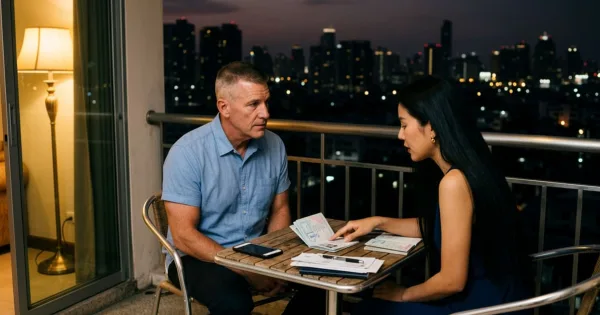
I checked her passport, her certificates, years of photos. It all lined up. It cost me $30,000 to learn that wasn't enough.
At 57, living in the quiet peace of a marriage that survived my wife's third affair, I met Pre at a bar in Nana Plaza, Bangkok. She was 37, looked 25, and had a perfectly verifiable story: passport, divorce papers, years of social media photos. Over six months I sent her 30,000 dollars for her family, her studies, and a Denmark visa that never came through.