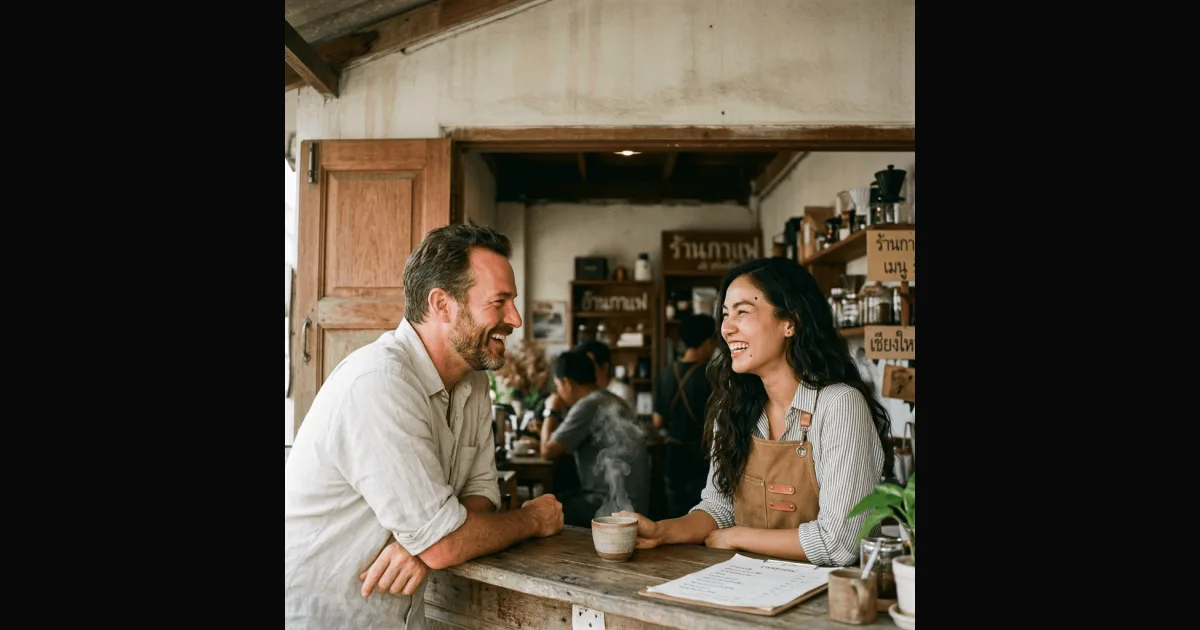
I went to Bangkok to see the world. In Chiang Mai I found something I was not looking for.
In short
A 45-year-old American arrived in Thailand with no plan at all. In a small Chiang Mai café, one genuine smile changed the entire course of his life.
I did not come to Thailand looking for love.
I say that because it is important to be clear from the start. When you tell a story like this, people assume things. They assume you were a lonely, broken man searching for something you could not find at home. And in a way they were right, just not in the way they think.
My name is Daniel. Forty-five years old. Tech consultant from Seattle. Divorced three years ago, no kids, with a job I could do from anywhere in the world as long as I had WiFi and a decent cup of coffee. I had been exploring Bangkok for months when I decided to get on an overnight train to Chiang Mai, basically because a guy in a hostel told me it was different and that if I had not been there I had not really been to Thailand.
That piece of advice changed my life. Not dramatically, not in that moment. But the chain of decisions that started on that train platform at eleven o'clock at night ended with my name on a marriage certificate in Chiang Mai two years later.
---
I arrived in Chiang Mai on a Tuesday morning.
I dropped my backpack at the guesthouse, showered, and went out to walk without any particular direction through the old city. There is something about Chiang Mai that Bangkok does not have: space to think. The streets are wider, the pace slower, the air — though not exactly clean — feels less heavy than the capital.
Mid-morning I walked into a small café, the kind with no English sign but three people sitting outside with laptops looking like they had been there for hours. The kind of place you find when you have been travelling long enough to stop looking for the nearest Starbucks.
I ordered a coffee with milk in my terrible Thai. The woman behind the counter laughed — not unkindly, but the way someone laughs when something genuinely strikes them as funny — and answered me in perfectly fluent English.
Her name was Noi.
---
Twenty-nine years old. Chiang Mai born and raised, she had studied linguistics in Bangkok and come back home after a couple of years working at a luxury hotel in Sukhumvit. The café belonged to her aunt. She managed it three days a week while building her own freelance translation business.
I learned all that in the first conversation, which lasted longer than a coffee with milk. Then longer than lunch. By mid-afternoon I was still sitting on the same stool and she was still talking to me between customers.
It was not love at first sight in the cinematic sense. It was something more interesting: the realisation that I had been having ten-minute conversations with everyone for months, and that suddenly I was having a real one.
We talked about languages, about how Thai has tones that make a single syllable mean five different things depending on how you say it. We talked about Seattle, about the rain, about why someone would voluntarily leave a place that rains nine months a year. We talked about what it means to go home when you have been away for a while and whether that ever stops being complicated.
I came back the next day. And the day after that.
---
There are 16 years between Noi and me.
We did not ignore it, we did not pretend it did not exist. But we did not give it more weight than it deserved either. Noi was a 29-year-old woman with a clarity about what she wanted from life that I had not had at her age and do not have now. She did not treat me as an older man with experience who would show her the world. She treated me as someone she wanted to share hers with.
That is an important difference.
The first few weeks were what people call dating although neither of us used the word. Coffees that became lunches that became walks around the moat of the old city when the afternoon heat eased a little. Nights at the Wualai Sunday market, where Noi greeted half the vendors by name and I tried to correctly pronounce the name of whatever food she was buying me.
She taught me to ride a scooter on roads that no GPS knew about. Blooming rice fields. Sunflower fields in season. Karen hill tribe villages she had visited as a child with her family.
The Thailand that Noi showed me was not in any travel guide.
---
Two months in, she introduced me to her family.
Her mother. Her father, a quiet man who worked in construction and who looked at me throughout the first dinner with the expression of someone who is evaluating something and has not yet reached a conclusion. Her grandmother, who spoke no English at all but who served me more food every time my plate threatened to drop below seventy percent capacity.
The age difference was the topic that was not named but that was in the room. I felt it in certain looks. I felt it when Noi's father asked me, using her as translator, what I did for work and whether I intended to stay in Thailand.
I did not lie to him. I told him I had no fixed plan, that I worked remotely, that Chiang Mai had surprised me more than I expected.
He looked at me for a long moment after hearing the translation.
Then he nodded and served me more rice himself.
That was his way of telling me something. I am not sure exactly what, but I knew it was positive.
---
I stayed.
It was not a dramatic decision, there was no moment of epiphany. It was more that the trial month became two, two became four, and at some point I stopped having a departure date in my calendar and started having visa renewal appointments.
I rented an apartment in the Nimman neighbourhood. Noi and I started spending more nights than mornings together, which is a polite way of saying we were basically living together before either of us said it out loud.
My work ran perfectly well from there. Client calls with Americans I made in the early hours Thai time, which was mid-afternoon in Seattle. The rest of the day was mine.
I started learning Thai seriously. Not tourist Thai of "sawadee khrap" and numbers one to ten. Real Thai, with classes three times a week with a teacher named Arthit who had infinite patience with my inability to distinguish tones.
Noi laughed every time I practised at home. Not unkindly. The same way she had laughed the first time I tried to order a coffee.
---
We got married on a Saturday in November, nineteen months after that first conversation in the café.
The wedding was in Chiang Mai, in the garden of Noi's parents' house. Fifty people. Buddhist ceremony in the morning, which lasted three hours and of which I understood approximately twenty percent but which was one of the most beautiful experiences of my life. Food for an army. Music until well past midnight.
My mother flew over from Portland to be there. She was seventy-two and had never left North America. She spent the entire ceremony with wet eyes and by the end of the night was dancing with Noi's grandmother, who also spoke no English, but apparently dancing does not need it.
My mother whispered to me before she got on the plane home: "This woman has given you back something I did not know you had lost."
I did not ask her what exactly. It was not necessary.
---
Two years have passed since the wedding.
I am still in Chiang Mai. Noi's translation business has grown to three employees. I have cut my American client list in half and started working with Asian companies that need technology consulting with a Western perspective.
At weekends we still ride scooters to places that are not on any map. We still eat with Noi's family on Sundays. Her father and I have developed a communication system that consists mainly of nodding, smiling, and watching football together in silence.
It works perfectly.
If you are reading this from somewhere where life feels too predictable, too orderly, too much like yesterday, I am not going to tell you to book a flight to Thailand and that love is waiting for you in a café in Chiang Mai.
But I will tell you this: sometimes the best chapter of your life starts when you stop trying to control the plot.
Continue reading
Related stories
A 28-year-old Thai nurse and the 71-year-old German who came to Chiang Mai to die
A 71-year-old German man came to Chiang Mai looking for a quiet place to die. A 28-year-old Thai nurse gave him back his will to live instead.
I came to Thailand for two weeks. That was two years ago and I am not going back.
A retired electrician went to Thailand for a two-week holiday. At a night market, a woman said something to him that changed his entire life forever.
He was 70 years old and his wife had died. His daughter booked him a flight to Thailand.
At 70 he became a widower after forty-three years of marriage. His daughter booked him a flight to Koh Samui that gave him back what he thought was lost.

I arrived in Bangkok convinced I would be the one helping her. I was wrong.
A British man arrived in Bangkok carrying every prejudice about Thai women intact. What he found instead was a woman who did not need saving at all.

Six hundred thousand baht. Eighteen months. And a 29-year-old American I never met.
A retired teacher thought he was building a future with Lek. Eighteen months and six hundred thousand baht later, he learned who he was really funding.